
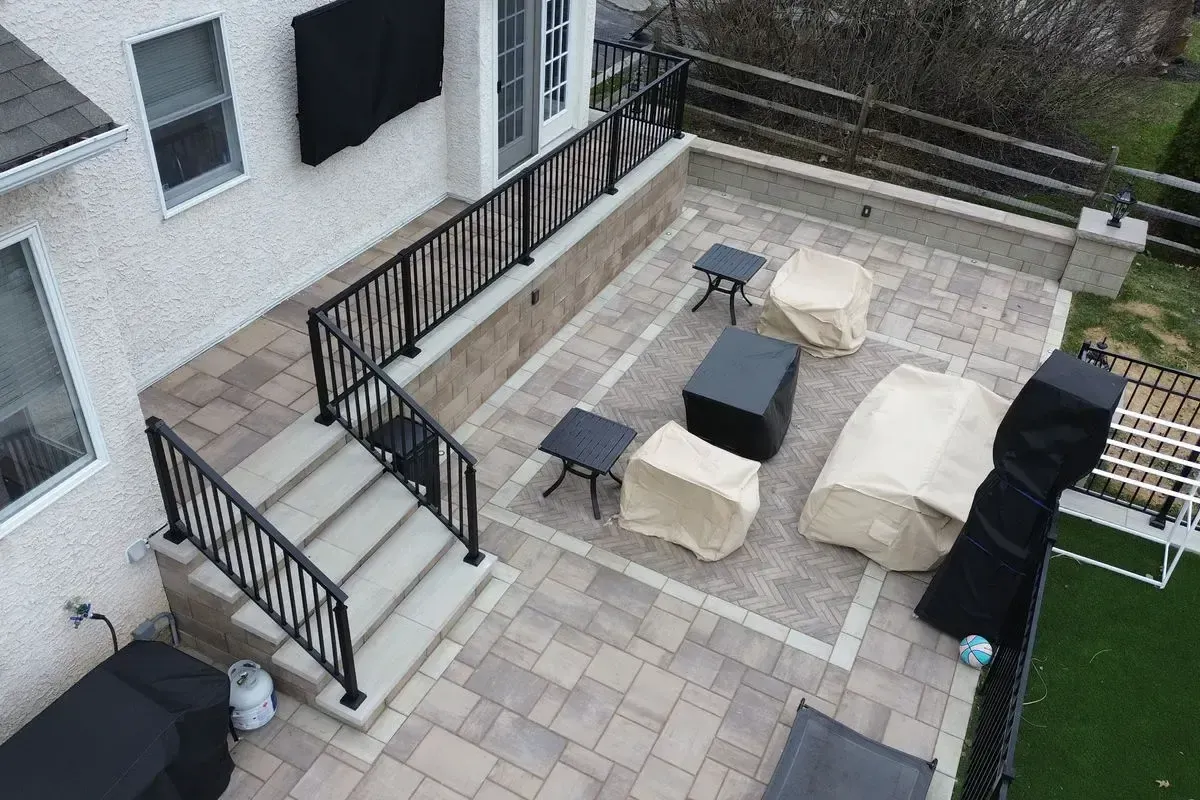
Patio Drainage Problems in Chester County: Why Water Pools and What to Do
Start with the path of the water
Water that repeatedly pools on a patio is a reason to investigate the way the whole area drains. The visible puddle may be the low point, while the water arrives from a downspout, adjoining slope or another part of the yard.
Before choosing a drain or replacing the surface, gather observations and ask for a site-specific assessment. Keystone Hardscape & Design offers drainage services and patio installation in Chester County and nearby areas.
Record what happens during and after rain
From a safe place, note where water first enters the patio, where it collects and where it leaves. Take photographs at different points in the same rain event, then record whether the area remains wet afterward.
Include the edges of the patio, nearby downspouts, steps and adjoining planting beds. Tell the contractor whether the problem is recent, follows landscaping work or has been present since installation. Do not block a drain or redirect runoff toward a neighbor as an experiment.
A simple sketch can connect the observations. Mark the house, patio, higher ground and any visible inlet or outlet. This gives the assessment a better starting point than a photograph of one puddle.
Separate surface water from water below the patio
Surface drainage concerns the water moving across the top of the patio and surrounding ground. Subsurface drainage concerns water in the underlying material. They can interact, but the remedies are not automatically the same.
A French drain typically uses a subsurface collection arrangement. NDS explains the components and applications of French drains, including the importance of a suitable drainage path. Installing one without understanding the water source and destination may fail to address the visible problem.
Ask the assessor to explain what evidence supports a surface correction, a subsurface system or a combination. “Add a drain” should come with a location, purpose and discharge plan.
Compare solutions against the cause
Depending on the assessment, a proposal might discuss resetting affected pavers, correcting grades, modifying a downspout connection, adding a collection inlet or channel drain, or redesigning part of the area.
Ask what happens at thresholds, steps, foundations and neighboring surfaces after the change. A repair should not solve one low point by creating another unwanted flow path.
Also ask what will be done beneath a disturbed section. If the cause includes settlement or unsuitable supporting material, resetting the surface alone may not be the complete scope. The contractor should explain which conditions can be established during the visit and which require further investigation.
Do not confuse ordinary pavers with a permeable system
A joint between pavers does not by itself establish that a patio was designed as a permeable pavement system. Purpose-built permeable systems involve coordinated surface, joint and underlying construction, together with a maintenance plan.
If permeability is part of a proposed solution, ask for the system design and how it suits the site. Avoid assuming that swapping the top units or removing joint material turns a conventional patio into a stormwater system.
For a wider comparison of surfaces, see our stamped concrete and paver guide. Drainage planning should accompany the material decision rather than follow it.
Confirm where collected water may go
Drainage planning includes the receiving area as well as the collection point. Ask the project team to confirm applicable municipal requirements, any necessary approvals and whether the proposed discharge affects adjoining property or existing drainage infrastructure.
Chester County’s stormwater ordinance information provides county-level context. Confirm the requirements that govern your address and scope with the responsible municipality rather than assuming one rule applies to every patio repair.
Request a written plan and a maintenance handover
Bring your photographs and sketch to the consultation. Ask the proposal to describe the diagnosed issue, work area, supporting construction, drainage route, restoration and any conditions that could change the scope.
Before handover, ask how to keep inlets, outlets and nearby surfaces clear and what signs should prompt a follow-up. Contact Keystone Hardscape & Design to discuss your patio and drainage concerns. The most useful first result is an explanation of where the water comes from and how the proposed work will manage it.